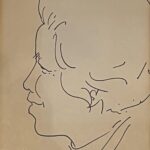
Eulogy for Mary Tchunki Fan Huang
by her grand-daughter Eliane Kinsley, January 30th 2009, Saint Basil's Church, Toronto
Note: I did not know then all I know now. Tempting as it might be to add in references to her writing (or tighten up the text here and there) I have I have reproduced the eulogy here as delivered in 2009. – EK March 2026.
When my grandmother chose to be baptized a Catholic in her early twenties, it was, she told me once, because she was moved by the gospel of love. It makes sense, I think: she was an emotional person, passionate even (she once described herself as coming from “a line of hot-headed autocratic Fan women”) and she had little time for abstract argument and theoretical discussion. They left her cold, and she believed in warmth. It makes sense that her faith was born of feeling.
The importance of loving and being loved was central to her.
Tragically, many of the people she loved were taken from her early: Her father and mother when she was a child, her Sister Seven who was like her second mother, and later, her son Luc and her daughter Therese, whose loss she never got over.
Yet throughout her life, carrying her burden of grief, she carried on and fought to live with dignity, to provide for her family, to better herself and those around her. She lived frugally, putting everything into her children’s education, and later contributing to that of her grandchildren and great-grandchildren.
Her love of learning is legendary in the family, and if her studies were repeatedly interrupted (she often mourned not completing her French education, nor having a solid foundation in Chinese) she persevered, so that by the age of fifty, she passed the exams for working in the US government service (this in her third language… or fourth or fifth if you count the different Chinese dialects she spoke), and enrolled in college courses in English literature, later studying Russian, among other things.
Most people remember her as always carrying a book, and reading was her constant occupation at leisure. She liked history – not abstract isms but the drama of character, of flesh and blood actors in the world – and novels. To me she resembles Jane Eyre: circumstances made her invisible; inside she is all fire.
She was also a great storyteller, not only a reader of stories. Anyone who took the time to listen would be rewarded by the tales she told, of family history especially, like fairy tales…
Though her life had moments of high drama (the revolutionary activities of her siblings, the wartime crossing to France when ships ahead of and behind hers were sunk, her act of bravery in intervening when an armed man threatened her colleague in the Navy offices, and so on) she was happiest, I think, when she could be of service, when she could help things run as they should. Some of my happiest memories are of mundane daily rituals we shared – when she moved in with us, I started coming home from school for lunch, and she would fix me (in my memory it is always the same meal) a grilled cheese sandwich and soup, and then I would practice the piano, and go back to school… and that’s the kind of thing that pleased her: family members supporting each other, the grandmother helping the granddaughter, some conversation, and then improvement and education.
If love, especially family love, was central for her, giving and receiving it was not always simple. Her demonstrations of love were not always received as intended, and she had been hurt often enough to be wary. She could be intense, all or nothing, prickly; she didn’t always make it easy. For years she refused a hearing aid. Make the effort, I felt she was saying: prove you care. When a few years ago she did accept to put on headphones and hear us speaking into a microphone, I feel that this was a concession; she was telling us that she would let us love her, that she was willing to accept the love offered; however flawed, however imperfect, it was welcome.
I’d like to leave with you one last image.
Poh-poh always said she didn’t have a green thumb, that plants in her care never thrived. “Overwatering,” my mother would intone gloomily – a sad example of killing with kindness. Once though, Poh-poh decided she could handle a cactus garden, perhaps seeing something kindred in those prickly survivors. We chose the planter boxes, bought the special potting soil with excellent drainage, and transplanted a variety of little cacti. They sat on the dining room ledge and did pretty well. A few specimens died off but in general they survived, looking much as they had when we bought them. When Poh-poh left the house and moved to the nursing home in Toronto, the cactus garden was pretty much forgotten. Every once in a while I would notice it, some plants growing strange and spindly, others withering away into leathery husks. Maybe Daddy or I would give it a drink, maybe not – we were not really thinking about plants much. Then one day I was arrested by the sight of a cactus flower – one of those outrageously bright, highly improbable, breathtakingly beautiful blossoms any cactus gardener will struggle so hard to coax out of their prickly charges. Somehow, the random combination of conditions had provoked this one specimen to flower. And I take that cactus flower to be a symbol of Poh-poh: Out of difficult and unlikely circumstances, something fiery and delicate, which refuses to be ignored, and gives a moment of heartrending beauty to those fortunate enough to cross her path.